


Owner-train your assistance dog with guidance and ongoing support
Training an assistance dog can feel overwhelming. From choosing the right dog and teaching trained tasks to navigating public access and understanding your rights, there is a lot to learn.
Our Scottish Assistance Dog Programme is designed to support disabled handlers who wish to train their own dog towards assistance dog standards.
Whether you're starting with a young puppy or already have an older dog, we provide structured training, practical guidance, and a supportive community to help you every step of the way.
Because owner-training shouldn't be something you have to do alone.
Who We Support
We support disabled handlers with a wide range of needs, including:
- Autism
- Mental health conditions
- Mobility disabilities
- Hearing impairments
- Vision impairments
- PTSD and military-related disabilities
Every team is unique, which is why training is tailored to your individual needs, goals, and circumstances.
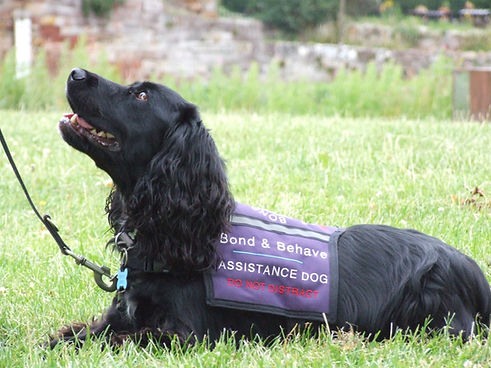

Is My Dog Suitable?
Not every dog enjoys assistance dog work, and that's okay.
Successful assistance dogs typically need:
- Confidence in new environments
- A willingness to engage with training
- Good recovery from stress
- Calm behaviour around distractions
- The ability to settle and relax when not working
Our programme helps assess suitability and supports teams
in making informed decisions throughout the training journey.
Two Ways to Join
Starting with a Puppy or Young Dog (Under 2 Years)
Our structured four-level programme helps guide suitable teams from foundation skills through to advanced assistance dog training.
You will work on:
- Engagement and focus
- Loose lead walking
- Confidence building
- Public manners
- Neutrality around distractions
- Trained task development
- Public access preparation
As your skills develop, training moves beyond the classroom and into real-world environments where assistance dogs are expected to work.
Joining with an Older Dog (Over 2 Years)
Already have a dog you think may be suitable?
We begin with an assessment to evaluate:
- Temperament
- Confidence
- Public behaviour
- Existing training skills
- Suitability for assistance dog work
From there, we'll help identify any areas that require further training before progressing towards a Public Access Test.
Some teams may only require minor improvements, while others may benefit from additional support through:
- One-to-one training
- Task training sessions
- Parallel walking sessions
- Weekly classes
Every team progresses at their own pace.
What Are We Working Towards?
The goal isn't simply to pass a test.
We aim to help teams develop:
- Reliable behaviour in public
- Strong handler-dog communication
- Disability-mitigating trained tasks
- Confidence in real-world situations
- High standards of welfare and public access behaviour
We want both dog and handler to feel capable, prepared, and confident in everyday life.

Trained Tasks
Under UK law, assistance dogs must be trained to perform tasks that directly mitigate their handler's disability.
As part of our programme, we require teams to develop a minimum of two trained tasks used regularly in daily life.
Task training is tailored to each individual's needs.
Examples include:
Please note: We do not currently offer scent-based medical alert training, including diabetic or seizure alert work.
Guide Dog Tasks
- Guide to Curbs
- Find Traffic Light
- Find exit
- Find bins
- Find bench
- Guiding around dangers
- Crossing roads safely
- Guiding between obstacles
- Forward Momentum
- Find a Person
Hearing Dog Tasks
- Alert to Fire alarm
- Alert to alarm clock
- Alert to Mobile phone
- Bringsel Training
Tasks at Home
- Emptying the washing machine
- Pulling the washing basket to the dryer
- Emptying the tumble dryer
- Medication Retrieval
- Changing Bedding
- Clean up items - Put items in a box or bin
Physical Tasks
- Picking up Items
- Removing clothing -Socks, Jumpers
- Sending away for Items
- Opening Doors
- Shutting Doors
- Carrying Items
- Pushing automatic Door buttons
- Turn on and off lights
Mental Health Tasks
- Cry interruption
- Self harm Interruption
- Light Pressure Therapy
- Deep pressure Therapy
- Lifting legs
- Nightmare Interruption
- Grounding
- Crowd Control - Blocking, Orbit and watch my back

Handler Education & Support
Training an assistance dog is about more than teaching the dog.
We also help handlers understand:
- Assistance dog welfare
- Public access expectations
- Equality Act guidance
- Responsible assistance dog ownership
- Managing access challenges and refusals
Support is available through:
- One-to-one sessions
- Group classes
- Community events
- Our private support network
Because successful teams are built through education, support, and community.
Important Information
Assistance dog training is highly individual, and not every dog is suitable for assistance dog work.
A dog's progress and potential outcomes depend on many factors, including temperament, health, welfare, maturity, training history, environmental influences, and the handler's ongoing commitment to training.
Participation in the Bond and Behave Assistance Dog Programme does not guarantee that a dog will successfully qualify as an assistance dog, pass a Public Access Test, receive identification from any organisation, or be granted legal access rights.
We reserve the right to advise that a dog is unsuitable for assistance dog work if doing so is in the best interests of the dog, handler, or public welfare.